
A day in the life...
I get questions all the time about what my schedule looks like. Goodness, it looks different EVERY day and every week. I'm still in the process of building up my clientele, so there are days when I have 6 clients and other days where I have none. There is no real consistency, which can be difficult and discouraging at times, but I also like that it keeps me on my toes. Anyways, I thought I would share a day in the life along with the foods I ate. Hope you enjoy!
6:00 AM Alarm went off
6:10 Got out of bed (mornings are a little more rough now that it's dark outside when I wake up)
6:20 Made Isaac breakfast
6:35 Curled hair, put on makeup, and got dressed
6:58 Poured myself a cup of iced Vietnamese coffee for my first session, because coffee...
7:00 Online session with an out-of-state client
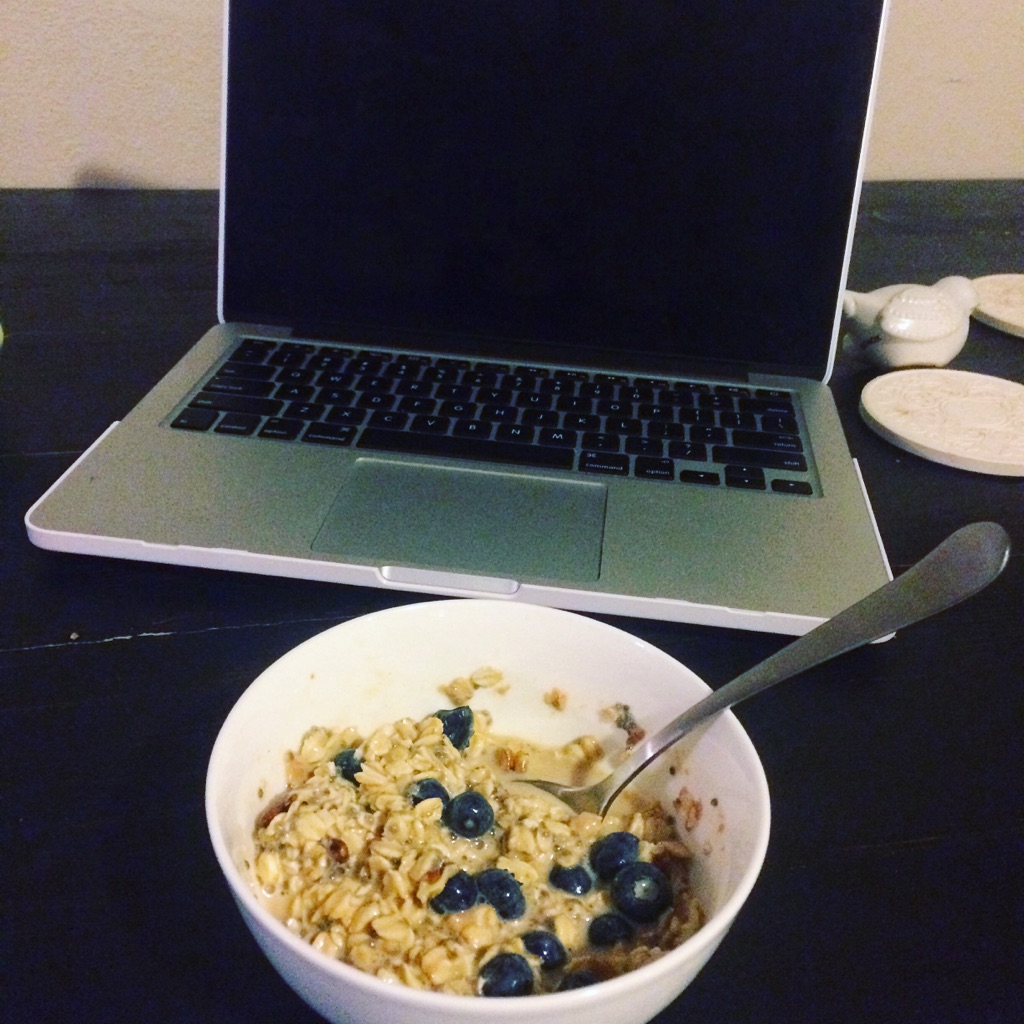
7:35 Ate breakfast-soaked oats and chia seeds in almond milk with pb2, maple syrup, blueberries, and pecans. Not pictured is a turkey and cheese rollup for some protein. 💪🏻
8:00 Left for work at my office
8:30 Client session
9:05 There is a Great Harvest Bread Company across the street from my office that I enjoy sitting outside at, so I walked over, got an iced latte and worked on some things on my laptop until my next appointment.

10:00 new session
11:00 client session
11:45 Headed home after my last session to get some lunch. I was getting really hungry so I ate half of a homemade rxbar to keep me from getting too hungry before lunch.
12:00 PM Made lunch: threw a bunch of leftover veggies in the skillet with eggs and topped it all with avocado, blue cheese crumbles, and pepitas. Served with a thin slice of banana zucchini bread and two chocolate covered almonds (not pictured).

I've got a little inside info for you. I felt a little uncomfortably full after this meal. Now, I don't want anyone comparing their usual lunch to mine--there are days when this wouldn't be enough. But on today day, it was a little more than enough. I just want you to know that I don't always "get it right" when it comes to my fullness cues. But instead of judging myself, I observed what led to me eating a little too much at that time. And guess what? Fullness subsides. I got hungry again later in the day. That discomfort of being a little over full goes away 😊
12:40 Washed dishes, vacuumed, etc while catching up on a show
2:15 Left to run some errands downtown
Can we just celebrate my parallel parking job?!

3:20 got to the YMCA to work out. I was a little sore from my workout yesterday, so I decided it would be a cardio day to work out the soreness. It felt really good to move my body
4:20 I ate the rest of my homemade rxbar while driving to get some last minute dinner ingredients at the store.

5:00 Started to make dinner
5:40 Isaac and I sat down to eat dinner. I had tried leftovers of this dish with my sis and wanted to make it afterwards, so I made it for the first time this night. So delish!

6:10 Talked to my sister-in-law on the phone about plans for getting together in a few weeks. She's the absolute best.
6:15 My 3rd night of cookies and cream ice cream with frozen cookie dough added 😍 while Isaac and I sat outside and I hung out on my laptop

7:05 Went for a walk around our apartment complex. It was 80 degrees outside and felt glorious!! I'm really going to miss the regular walks and incredible beauty when we move to our house.


7:35 We just hung out: worked on this blog post, web surfed, watched Friday Night Lights (SUCH a great show...so many warm fuzzy feelings..and a few tears). Had another thin slice of zucchini banana bread with peanut butter.
10:00 Hopped into bed. I meet with a girl from my church every week at 6 am, so it's gonna be an early morning.
Hope you all have/had a great day!!
Common misconceptions around beef nutrition
So, I'm a little nervous about this post. Why? Because people can have very deep convictions and beliefs regarding this topic. I'm not here to start a debate, I'm just here to share the information that has been shared with me. There is a lot of fear regarding this topic and I'm hoping to shed some light on it. Take what you want from it (or don't take anything at all).
If you read my recap post in May, you saw that I had the privilege of going on a conference with the Beef Council in Kansas City. We had sessions on beef nutrition, got to see an actual cattle ranch, and then even got to ask a panel difficult questions. I LOVED this portion of the trip because there are a lot of important questions that need to be discussed. I also loved that the people on this panel were well-educated, well-spoken individuals. So, I wanted to share some of misconceptions I hear or have had myself along with what is actually true.

Eating beef more than once a week is bad for your heart. The American dietary guidelines recommend less than 10% of daily calories come from saturated fats. In previous studies, there has been a link between saturated fat intake and heart disease. Just an fyi, this is currently being challenged, but the debate hasn't been settled (hence why I promote eating all foods--any food is harmful in too large of quantities). It's true that beef is a source of saturated fat, but over the past 55 years, the fat content of beef has actually decreased due to better butcher and trimming processes. In fact, there are 29 cuts of beef are as lean or more lean that a chicken thigh. A study* published in 2012 compared a typical American diet to the DASH diet (the dietary pattern recommended to decrease heart disease and high blood pressure--it is low in beef and high in white meats), a diet containing a 3 oz serving of lean beef everyday, and a diet containing 5.3 oz of lean beef everyday. The researchers found that all three (DASH, 3 oz lean beef, and 5.3 oz lean beef) groups had a decrease in LDL cholesterol and total cholesterol. I don't say that to promote beef over other types of meat, I just say that to take away the fear around eating beef. I think all types of proteins should be consumed; variety is key :-)
Additionally, beef is a reeeallly great source of protein, iron, selenium, magnesium, zinc, niacin, and B12. It can definitely be enjoyed as a part of dinner to promote nutritional wellbeing.
Grass-fed beef is better for you than conventional beef and should be the only beef you buy. Did you know that all cattle are grass-fed for the first 12-14 months of their lives? The difference is whether they are grass or grain finished. Now, there is a slight difference in nutrition profile and definitely a difference in taste. Grass finished cattle have a slightly higher omega 3 fat content, lower overall fat content, and lower calorie content than grain finished cattle. So how much of a difference? The infographic below is helpful for comparing. You can see that total fat and saturated fat is significantly less, but so is the amount of monounsaturated fat, which is supportive of heart health. You can see the difference in omega-3 content is .03 g. A 3.5 oz serving of salmon roughly provides 1.0 g of omega 3...

Graphic courtesy of the Texas Beef Council
I personally prefer to buy grass finished beef because of taste and because our grocery store regularly puts it on sale for $3.99/lb (which is super affordable). However, I'm not going to say "no" to conventional grain finished beef at a friend's house or restaurant, nor am I going to promote that people should buy only grass finished as a superior nutrition choice. It's just a personal preference for me. You do what works for you; it doesn't make that big of a difference. If you want to increase your omega 3 intake, you should be spending your time eating salmon, not beef.
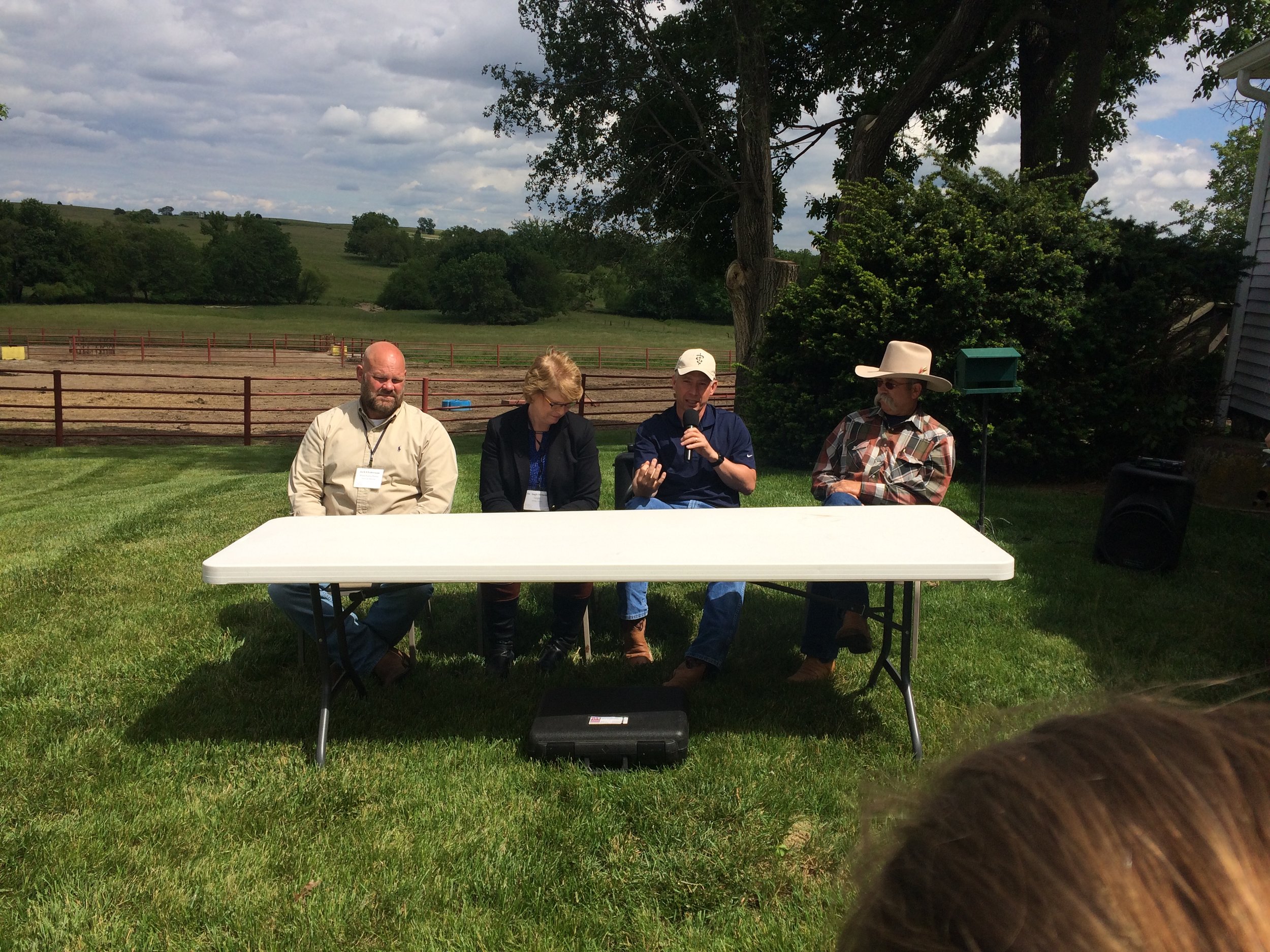
The beef panel we had the privilege of asking questions to
The hormones given to cattle are harmful to humans and are causing a majority of our health problems. You should only buy organic, hormone-free beef. I completely understand this concern: if it is true, I would want to limit my consumption as well. That is why I really paid attention during this part of the panel conversation. Let me give you a little background information: when cattle are brought from the ranch (where they are grass fed) to the feed yards, they are given an estrogen tab once behind the ear. This estrogen helps them to convert their feed into mass more quickly. The faster they can gain mass, the less time they are in the stockyard. Faster turnaround means lower expenses and higher profit for cattle ranchers. It also means decreased food consumption by the cattle. If the cattle industry didn't use estrogen, they would need significantly more feed (which means more land to produce this feed, higher costs, etc.). The cattle are in these feed yards for 4-6 months until they reach a certain weight and then are shipped to the stockyards for slaughter and packaging.
The argument given is that beef from cattle given estrogen is 40% higher than beef from cattle not given estrogen. Again, let's put this in perspective. The amount of estrogen found in 500 g (over a pound) of beef from an estrogen-given cow is 7 nanograms (ng); the amount of estrogen found in the same amount of beef from a non-estrogen-given cow is 5 ng. Two nanograms of a difference. What is that compared to other foods? Check out the graphics below.


Graphics found at http://www.iowabeefcenter.org/information/IBC48.pdf
As you can see, the amount of estrogen found in other foods is FAR greater than that found in beef or what is naturally made in our bodies.
Antibiotics given to cattle will cause antibiotic resistance in humans. You should only buy antibiotic free beef. When cattle are given antibiotics, there are procedures about the length of time required before being able to slaughter them (withdrawal period). These range from 0-60 days to ensure that there are no unacceptable levels remaining in the meat. Additionally, there are quality checks to ensure that the beef does not contain unsafe levels of antibiotics, bacteria, etc. The use of antibiotics and antibacterial soaps/cleaners/etc is of concern when it comes to antibiotic resistance in our modern world of medicine and should be taken seriously. However, we cannot develop antibiotic resistant diseases from beef without actually ingesting an antibiotic resistant bacteria in the beef, and this shouldn't be happening with our modern sanitation and processing laws. The concern is really with sanitation and cooking practices, not antibiotic use. Furthermore, the argument just isn't that simple. Yes, antibiotics can cause antibiotic resistant bacteria, but so can probiotics and zinc supplementation. It's not as simple as just stopping the use of antibiotics. I will say that I'm all for exploring more natural ways to prevent illness in the cattle (and humans!), but I am not going to fear eating beef that was given antibiotics because I trust the procedures set in place to ensure that the beef on my table does not contain antibiotics and I have a responsibility to handle and cook the beef properly.

This cattle rancher was SO sweet and funny; and his mustache is LEGIIIIT
So, there you go. A few thoughts to contribute to the beef discussion...I'm not even going to get into the "What the Health" conversation here...I hope this was helpful and not too wordy. Have a great week and enjoy some beef if that sounds tasty to you!
*MA Roussell, et al. Beef in an Optimal Lean Diet study: effects on lipids, lipoproteins, and apolipoproteins. Am J Clin Nutr. 2012 Jan; 95(1): 9–16. Published online 2011 Dec 14. doi: 10.3945/ajcn.111.016261

Why we need a point of reference in eating disorder recovery
I’m beginning to learn more about the use of metaphor in eating disorder recovery. Anita Johnston, the author of Eating in the Light of the Moon, stated that metaphor is so powerful because it accesses your the intuition, imagination, and emotions all at the same time. So when you make new discoveries, you create new brain pathways. New brain pathways=new patterns of behavior. Cue the analogy/metaphor (I google searched the difference between the two but didn't understand what it is, so I'm using them interchangeably 🙈)
I was reading my daily devotional the other day and it started by talking about a phenomenon called “museum feet.” I really enjoyed the analogy that it drew and began thinking about how it applied to my own life in various areas. I couldn’t find the phenomenon when I searched online, buuuuut I’m gonna go with it, because I think it can be really helpful. And if my analogy gets lost on you, I apologize…I’m still learning this skill. As the author of the blog described it, “museum feet” is the phenomenon that happens when someone is put into a very large space such as a museum, amusement park, etc. and gets overwhelmed with how vast it is that they just want to leave. They have no idea where they should go or what they should do that they just give up. In order to avoid this, architects put in a large landmark or point of reference. For example, in Disney World, it’s the magic castle. It’s something that people become familiar with and it helps them orient themselves to the new space. For me as a kid, it was the Big Kahuna at our local water park. Every time we would go as a family, my mom would tell me that if I got lost I just needed to go to the big Kahuna. I didn’t have to fear not knowing where she was, I just needed to find the massive water ride and head towards it.
So how does this apply to my life? I‘m in this new stage in which I see all of the possibilities in my career/social media and I also recognize all of the various things I need to do in order to grow in my skills and proficiency, and yet, it is SO overwhelming that I don’t end up doing anything. In this glorious park I've entered, I don’t want to try a new ride or play a new game, I just want to get back to something I know and find comfort in. There are no clear directions on what steps to take or the order of those steps, so I need my reference point. I need my “Big Kahuna”.
In what other areas do we open the gates of new opportunities and get so flooded with the vastness of uncertainty that we give up and go back to what we know? What do we miss out on in the park because of a lack of reference? In eating disorder recovery or exploration of a life without dieting, it is so easy to get overwhelmed with this newfound space of freedom that it’s too overwhelming. It makes sense that we don’t want to explore what life is like without calorie counting, over-exercising, restricting, overeating, bingeing, purging, etc. because that is what we know. We are familiar with every inch of that small world and incredibly unfamiliar with this new large one.
So what can we do to gain some reference? What landmark can we look to in order to ground us and keep us from feeling overwhelmed and giving up? I think this looks different for every person so you have to figure out what it is for you. Maybe it's personal time in the Word and prayer. Perhaps it’s your dietitian or therapist who points you in the right direction until you become familiar with this new space. Or maybe it’s a mindfulness practice that helps to decrease your anxiety and give you perspective. Maybe it’s developing a realistic, flexible plan that gives you something to refer to. Or perhaps it’s looking to other people who have recovered, are very familiar with the amusement park, and can give you directions. Figure out what can be your landmark so that you don't get so overwhelmed and give up. Discovering and exploring this new world is totally worth it.
How does this analogy/metaphor speak to you (if at all)? How could you apply it to your own life? I’d love to hear in the comments below!