The 10 Principles of Intuitive Eating
Heyo! How was everyone's weekend? Do anything especially fun? I'm guessing a few of you kicked back, had fun with friends and family, and ate a little more than you normally do throughout the week. And I bet a few you told yourself over the weekend or last night that you would "get back on your diet" or "start eating healthy" again today. Well, I'm here to say that you shouldn't get back on your diet and instead you should start incorporating some of the principles of intuitive eating.
Heyo! How was everyone's weekend? Do anything especially fun? I'm guessing a few of you kicked back, had fun with friends and family, and ate a little more than you normally do throughout the week. And I bet a few you told yourself over the weekend or last night that you would "get back on your diet" or "start eating healthy" again today. Well, I'm here to say that you shouldn't get back on your diet and instead you should start incorporating some of the principles of intuitive eating.

It's well documented that diets don't work in the long run. They leave us frustrated, ashamed, crazy around food, and heavier than before. It's actually been shown that dieters are more likely to gain weight than non-dieters, independent of genetic factors. It's also been linked to a higher risk of developing an eating disorder. So why do we continue to encourage dieting (ie. restricting food or caloric intake for the purpose of losing weight/changing our body) when it is only harming us in the long run? Why do we allow diet talk to infiltrate our conversations and the way we see food?
I did a post on intuitive eating awhile back and mentioned how it dramatically changed the way that I viewed food and my eating behaviors. I shared with you all the basic premise behind intuitive eating--that our bodies have a certain weight range they want to be at and are very adept at maintaining if we allow them to--and some points on what intuitive eating is and what it is not. Today I wanted to share with you the 10 principles of intuitive eating as defined by Evelyn Tribole and Elyse Resch.*
1. Reject the Diet Mentality. Quit believing the lies that the next greatest diet or weight loss tip is going to be what finally works for you. Let go of the idea that health is all about weight and that focusing on weight loss is the answer to health and happiness. Reject any promises of the false hope of losing weight quickly.
2. Honor Your Hunger. Your body will let you know when it needs more fuel. Learn to listen to this and honor it. If you allow yourself to get too hungry, you will overcompensate by overeating. Learn to trust your body's cues and let your body learn to trust that you will feed it when it tells you to.

3. Make Peace with Food. Let go of all of the fears associated with eating food that has been deemed "bad" or "unhealthy." Begin to give your permission to eat any and all foods. As you allow yourself to eat whatever you truly want, your cravings and binges will subside because you are no longer depriving yourself. Deprivation/restriction always leads to overeating/bingeing, whereas liberalizing food allows it to lose its power!
4. Challenge the Food Police. Tell that inner critic to shut up when it comes to food. You no longer have to live according to food and exercise rules. Your worth and value aren't found in your "disciple," "willpower," or "control," so don't be deceived into thinking they are. Learn to recognize those thoughts and change them into statements that are true.
5. Respect Your Fullness. Learn to listen to what fullness and satisfaction feel like for you. Check-in with your hunger and fullness throughout your meal and stop eating when you've reached your physical fullness.
6. Discover the Satisfaction Factor. Satisfaction is not only about what you eat or how much, but also the environment in which you each. Food was made to be savored and enjoyed. When you find yourself eating the food you really want in a pleasant environment, satisfaction and contentment will increase and your need for more food will decrease.
7. Honor Your Feelings without Using Food. Emotional eating is part of being a normal and competent eater. We cannot eat in an emotional vacuum! However, it is when we use food on a regular basis as a way to fill an emotional void or resolve our problems that we are using food in a way that it wasn't intended. Food cannot give you emotional intimacy, change your circumstances, or heal your pain. Learn to address those feelings or situations in a way that will actually resolve them.
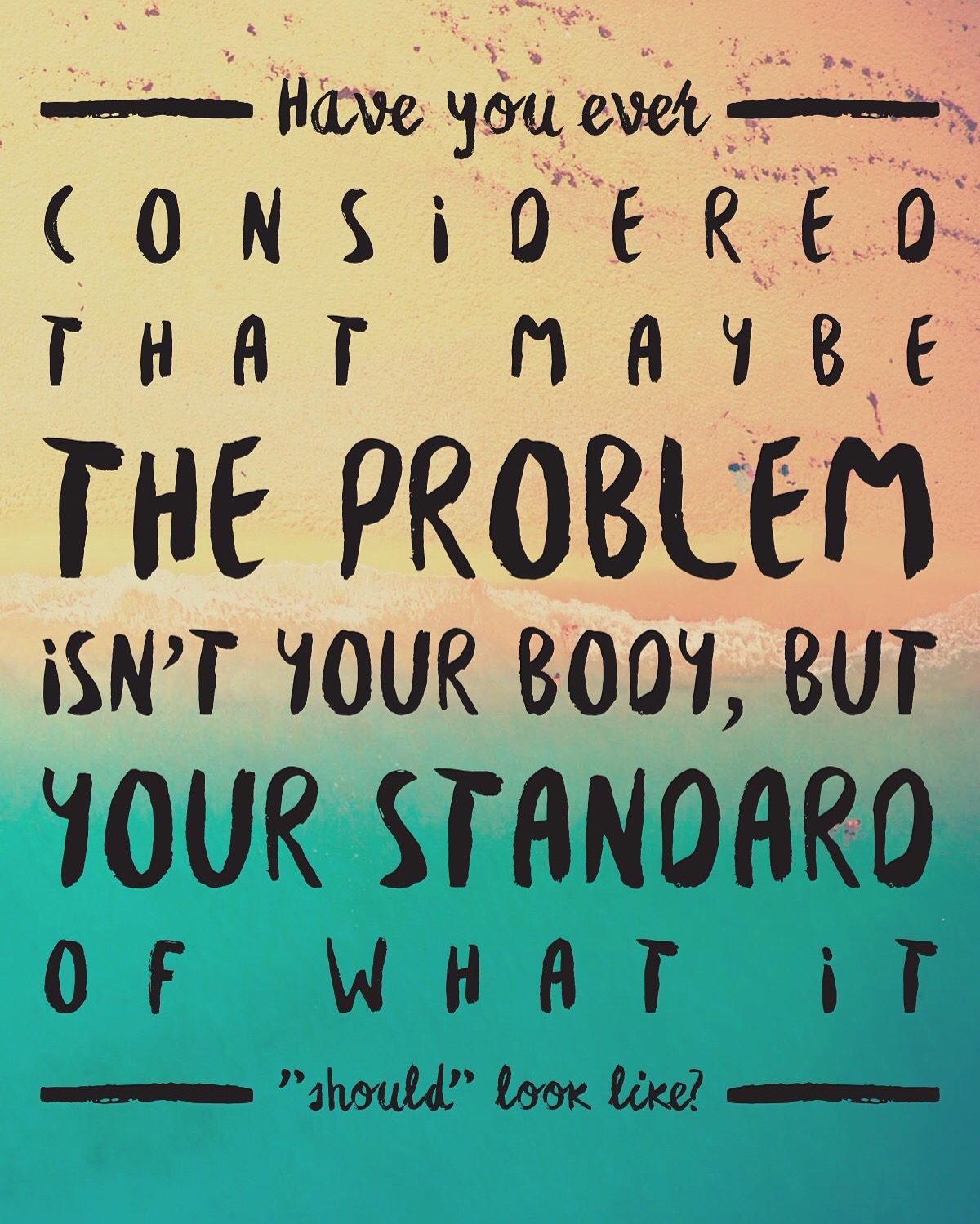
8. Respect Your Body. Respecting your body is different from loving your body. You don't have to love it, but recognizing all that it does for you and then taking care of it is super important. We were not all created to be the same shape or size. My size 8.5 foot is no better or worse than my friend's size 6.5 foot. We're just different. Disrespecting your body and wishing it were different (despite it being how you were MADE) will not allow you to reject the diet mentality and eat all foods without fear or restriction.

This picture is from an article on Refinery29 on rational fitness. Check it out!!
9. Exercise--Feel the Difference. Moving your body is super important. However, just as weight does not equal health, exercise does not equal health either. Both are one of many factors in the health equation. Learn to move your body for the mental, emotional, and physical benefits rather than the calorie-burning effect. Exercise is not about punishing yourself, changing your body, or earning your food. It is about respecting your body and making it feel good.
10. Honor Your Health. "Make food choices that honor your health and taste buds while making you feel well. Remember that you don't have to eat perfectly to be healthy. You will not suddenly get a nutrient deficiency or gain weight from one snack, one meal, or one day of eating." Also remember than sometimes honoring your health means doing things that don't appear "healthy." When exercise starts to control you or food becomes more restrictive, taking a day off (or maybe even a week or two!) at the gym or eating a less nutritious meal can actually be very healthy for you mentally and emotionally.
I know that was a lot of information to take in, but I hope there were points that really resonated with you! What is one principle you can begin to work on today??
*Tribole, E., & Resch, E. (2012). Intuitive eating: A revolutionary program that works. New York: St. Martin's Griffin.

Easy Ways to Get Your 5-A-Day Part 2
And first on the list are brussels sprouts. People feel pretty negatively about them. But I think they've just gotten a bad rap! Poor, poor brussels. Roasting them is the perfect way to get rid of their bitter flavor and then they can be seasoned various ways or served along with scrambled eggs. Or at least that's what I do...
Hello!! I'm back with the second part of the series I promised!
And first on the list are brussels sprouts. People feel pretty negatively about them. But I think they've just gotten a bad rap! Poor, poor brussels. Roasting them is the perfect way to get rid of their bitter flavor and then they can be seasoned various ways or served along with scrambled eggs. Or at least that's what I do...

Aren't those just beautiful up there ^^^?!? I'll stop being weird now...Cut off the ends of the brussels, chop in half and mix with olive oil, salt, pepper, and minced garlic. Roast at 425 for 20 minutes or until cooked fully. Add thai sweet red chile sauce and mix thoroughly. I added 1 Tbsp to the amount shown here, but you do you.


Vegetable numero dos: CAULIFLOWER! I know, I sound absolutely nuts. But it is so so good. Seriously. I love it roasted, in this cauliflower calzone, in stir-fry's as "rice," or steamed and covered in melty cheese <3. It's one of the best things you can put in your mouth.


For a stir-fry, just put a head of cauliflower in the food processor and pulse for a few seconds until it reaches a rice-like consistency. Then sauté it in some sesame or olive oil and use it as you would regular rice or fried rice. I even like to do a combination of rice and cauliflower rice so that I get the staying power of the carbohydrates and the nutritional benefits of the veggie!

For the mac-n-cheese cauliflower, cut half a head of cauliflower into bite-sized florets. Place in a large microwavable bowl, add a few tablespoons of water, and cover with a lid and microwave until tender (7-10 minutes). Meanwhile, add 1 oz. cream cheese, 1/3 cup shredded havarti cheese, 1/2 tbsp spicy brown mustard, garlic salt, pepper, and a splash of milk in a saucepan. Once the cauliflower is steamed and the cheese mixture is melted, add the cauliflower and coat. Feel free to add more cheese if you want. I mean, can you have too much cheese in your mac-n-cheese?
Last, but not least, I have for you a fruit-filled breakfast. I discovered this oatmeal awhile back and used to eat if everyday. The whipped banana thickens up the oatmeal and also gives it a natural sweetness without needing to add any extra honey or sugar. Combine 1/2 thinly sliced banana, 1/3 cup oats, 1/3 cup milk, and 1/2 cup water in a saucepan and bring to a boil. Once it starts to boil, quickly stir to "whip" the banana into the oats. Once cooked, add ground flax seed, chopped walnuts, peanut butter, and chopped apple. See what I did there? Bananas AND apples. :-D

Hope you all have a wonderful, fruit and veggie filled day! And if not, there's always tomorrow :-)

What Is Intuitive Eating?
I mentioned in my last post that I have been learning about and incorporating the principles of intuitive eating into my own life. I also mentioned how much freedom I have found in my own life regarding food and exercise with this new mindset shift. I wanted to share with you all about this approach in the hopes that you find some freedom yourself! Expect more posts to come on this subject.

I mentioned in my last post that I have been learning about and incorporating the principles of intuitive eating into my own life. I also mentioned how much freedom I have found in my own life regarding food and exercise with this new mindset shift. I wanted to share with you all about this approach in the hopes that you find some freedom yourself! Expect more posts to come on this subject.
Intuitive eating is a term used by many different people with varying definitions, but the intuitive eating approach I am talking about is a defined approach with specific principles and research backing it up. The major leaders of this framework are the authors of "Intuitive Eating": Elyse Resch and Evelyn Tribole.
The basic premise is that we are all created with a certain set-point weight range. Our bodies are incredible at maintaining homeostasis within a narrow range that is healthy for us. For example, our body maintains a very specific pH range and has compensatory processes that occur (increasing or decreasing breath rate, releasing bicarbonate from the kidneys, etc.) if it falls above or below the normal/healthy range. Similarly, our body maintains a set range of body temperatures. When your body temperature increases, you sweat to cool down. When your body temperature gets too low, you shiver to generate heat and your blood vessels constrict to prevent heat loss at the surface of the skin. In the same way, our body has a set range that it wants to maintain our weight at.
Some people have a higher set point and others have a lower set point. But regardless, this set weight range is healthy for THEM. We can see that the body wants to maintain this weight range, because when we lose weight or gain weight, our body begins to enact biological processes to bring us back to our healthy weight. To give an example, when we gain weight above our set-point, our fat cells produce leptin, a hormone that decreases hunger and increases our metabolism. If we are in-tune with our hunger and fullness signals (a principle of Intuitive Eating), then we eat less and our weight naturally decreases. If we lose weight below our set-point, our leptin levels decrease, increasing our hunger and decreasing our metabolism. This is one of the reasons why it is so hard for people to lose weight and keep it off (they are fighting physiology!).
So to summarize the foundation of intuitive eating--we have a natural weight that our body wants to be at and will maintain on its own, if we will listen to it. One of the major premises of Intuitive Eating is rejecting the dieting/restricting mentality and instead learning to listen to our bodies and to feed them when they're hungry and to stop when they're full. Instead of letting outside factors (diets, food rules, etc.) determine our food intake and exercise patterns, we allow our bodies to tell us what, when, and how much to eat. Sounds like a crazy concept, but it's something our bodies were designed to do! We have simply just shut it down for so long. My newborn nephew (the CUTEST baby in the entire world!!) knows when he is hungry and stops on his own when he is full. We need to learn to get back to this.
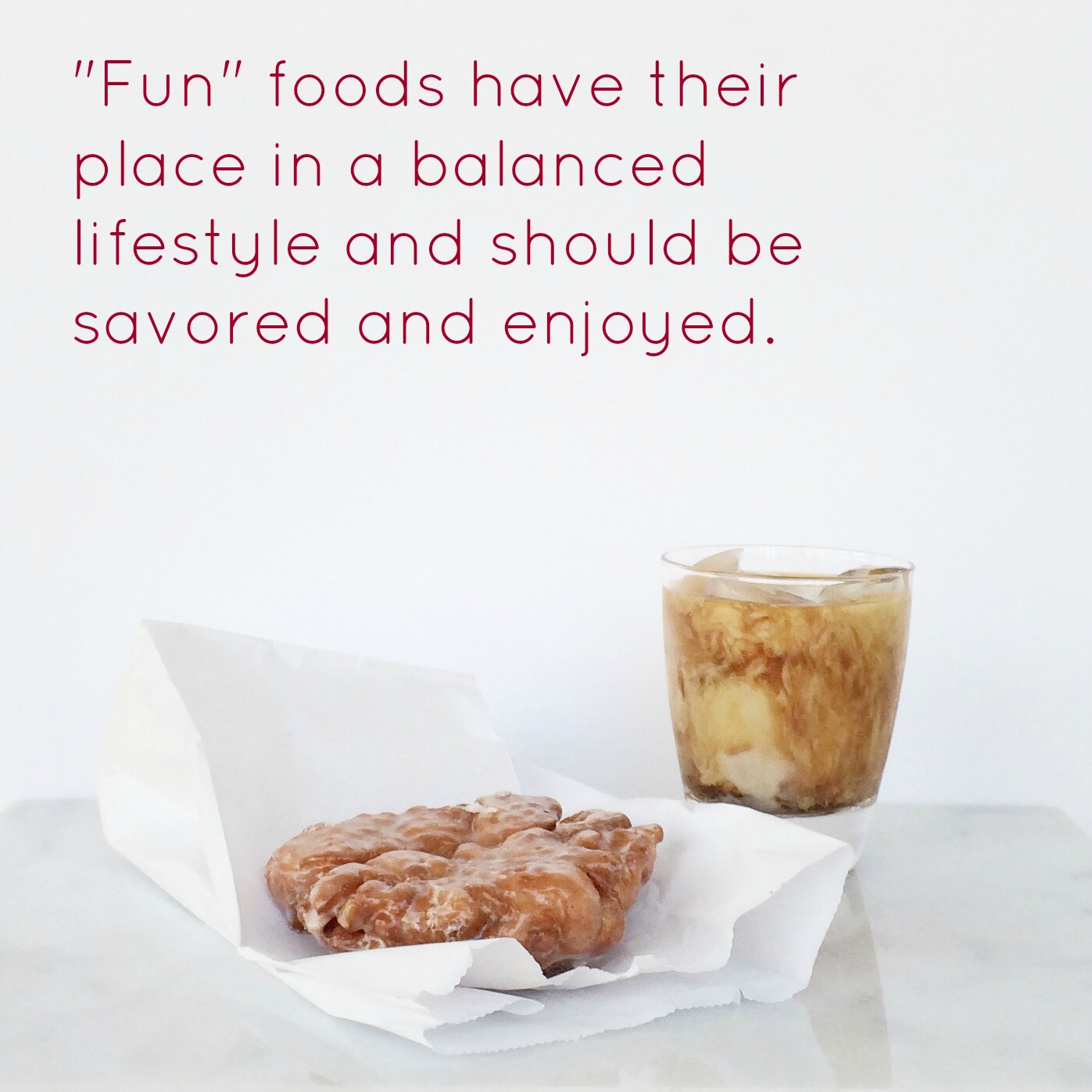
With intuitive eating, no foods are off-limits. You choose foods that will satisfy your hunger and your taste buds. And while you eat, you focus on being present to taste your food and enjoy the experience. When you purposefully choose your meals based off of the food being low-calorie/low-carb/low-fat (or whatever food rules you follow) instead of satiety and taste preference, you miss out on being truly satisfied, leaving you feeling hungry/deprived and thinking about your next meal or snack and eventually overeating later on.
I haven't quite gotten into all of intuitive eating, but there are misconceptions about the principles of Intuitive Eating and fear about this approach due to those misconceptions. So here is what Intuitive Eating is NOT:
- A diet or means of lose weight. Weight loss may be the result of learning to listen to body cues, but it is NOT the focus of intuitive eating--overall health is.
- An excuse to exclusively eat junk food and sit on the couch 24/7. Intuitive eating is about listening to the body, respecting it, and taking care of it through gentle nutrition and joyful movement.
- An excuse to eat an entire box of donuts in one sitting every day. Unconditional permission to eat is part of intuitive eating. But this permission goes in hand with attunement to the body--eating an entire box of donuts would take you past your fullness cues as well as make you feel very sick. Additionally, once food is no longer off limits, the desire to binge goes away because you know you can come back to it at any time.
- One size fits all. Every body is different, and therefore, each person's journey looks different. Your nutrient and movement needs look different from mine.
- Permission to use food as a coping mechanism. Intuitive eating encourages learning to identify what you REALLY need and then meeting that need with what will actually satisfy it. If your body truly needs food, then it is perfectly fine to feed it. However, if what you really need is a nap or a bubble bath or a short walk, meet your need with one of those options instead of food.
This post could be a novel (I know, it's already pretty long), but I will stop here. Like what you see so far? Would you like to make peace with food and your body? Stay tuned for my next post about Intuitive Eating where I explain the ten principles involved in becoming an intuitive eater. Let me know what your thoughts/questions are!!